
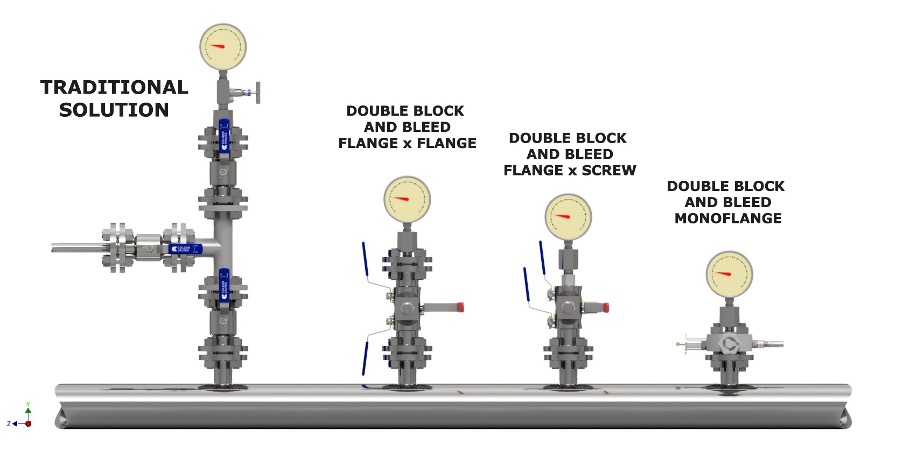
In process pipelines, the ability to isolate, vent and maintain without taking a system offline is often the difference between planned maintenance and unplanned downtime.
A Double Block and Bleed (DBB) valve combines two inline isolation valves and one vent/drain valve into a single manifold unit. The two block valves provide positive dual isolation; the bleed valve allows the medium trapped between the isolates to be vented or drained. Together, the three functions allow maintenance, repair or instrument replacement to be carried out while the wider system remains in operation.
Typical applications include the isolation of pressure instruments such as gauges and pressure transmitters, and isolation within the main process pipeline to allow safe downstream maintenance and protect the operator. If you’re new to DBB? Our article What is a double block and bleed valve? DBB explained is a useful introduction.
Configurations
Colson manufacture DBB valves across three standard configurations: Double Block and Bleed (DBB), Double Block (DB), and Single Block and Bleed (SBB).
The typical valve arrangements within these configurations are:
- Ball (isolate) / Needle (vent) / Ball (isolate)
- Ball (isolate) / Ball (vent) / Ball (isolate)
- Ball (isolate) / Needle (vent) / Needle (isolate)
- Ball (isolate) / Ball (isolate)
- Ball (isolate) / Needle (vent)
Where DBB valves are used
DBB valves are specified across oil and gas, petrochemical, chemical, hydrogen, subsea and sustainable aviation fuel (SAF) industries.
They are used across a wide range of system types: FPSO vessels, modular systems, skids and panels, chemical injection systems, wellhead control panels, fine filtration systems, gas dehydration units (GDU), produced water treatment (PWT) systems, sand treatment and removal packages, corrosion monitoring systems, analyser skids and flare skids.
End users of Colson DBB valves include Shell, BP, ExxonMobil, Chevron, Aramco, ADNOC and Petronas.
The integrated design advantage
The alternative to a DBB manifold is a traditional configuration: two separate single-isolate ball valves connected via a spool piece, with a needle vent valve incorporated into the spool. Connecting all of these components – to each other and to the pipeline – is time-consuming, and more connection points mean more potential leak paths. As valve diameter increases, so does the time and labour required for installation.
Colson’s integrated DBB design addresses each of these issues.
Weight
Integrating the two block valves and bleed into a single manifold reduces overall weight compared to the equivalent traditional assembly. In offshore and modular applications, where individual component weights affect centre of gravity calculations, pipeline stress and support requirements, that has a direct impact on engineering and installation costs.
Space
Offshore environments offer minimal space. A single unit housing three valve functions reduces the overall footprint of the installation, lowers the requirement for additional supports and shortens the overall length of the assembly – all of which reduce cost.
Reduced leak paths
Fewer connection points mean fewer potential leak paths. In critical medium applications – H2S service, for instance – minimising leak paths is a health and safety requirement as much as an operational one. It also supports the industry’s wider drive to reduce fugitive emissions and minimises production loss from medium escaping to atmosphere.
Installation cost and time
On a traditional assembly, each single isolate valve must be connected to the spool piece, the spool piece to the needle vent, and the complete assembly to the pipeline at both ends. With an integrated DBB, the only connections required are at each end of the valve to the pipeline. Installation is simpler, faster and less costly – and the time saving becomes more significant as valve diameter increases.
The result, across all four areas, is a valve assembly that does more with less – less weight, less space, fewer leak paths and a simpler installation. And because the system stays online while maintenance happens, the operational case is clear.
To discuss your requirements, just get in touch with the team