
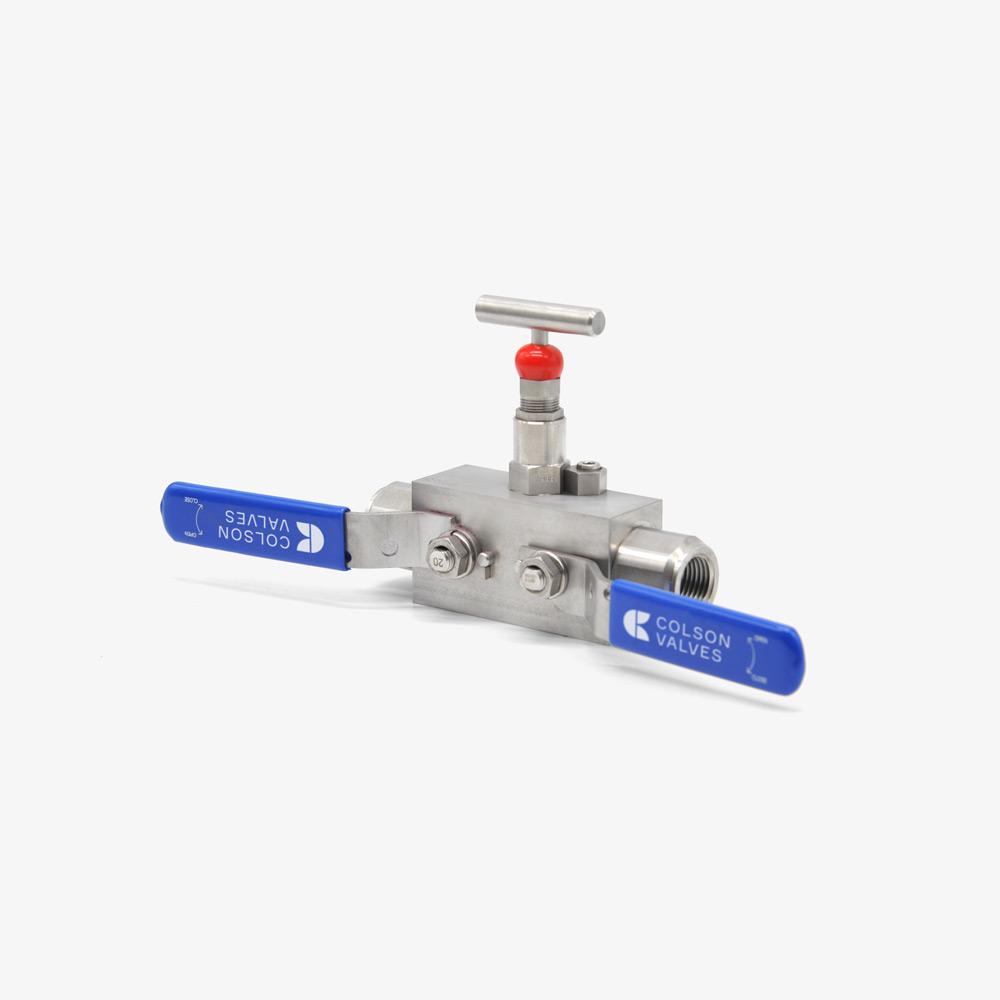
If you work with pressurised process systems, sooner or later a P&ID will call for double block and bleed isolation. This guide explains what a double block and bleed (DBB) valve is, how it works, and when it’s required.
The short answer
A double block and bleed valve provides two independent isolation barriers (the “blocks”) with a means of venting or draining the cavity between them (the “bleed”) all in a single, compact valve body. Closing both blocks and opening the bleed lets you prove the isolation is holding: if the first seal leaks, the leakage escapes safely through the bleed rather than pressurising the downstream side, and the second block provides back-up isolation.
That ability to verify isolation is the point. For maintenance on live plant – breaking containment to service an instrument, swap a gauge, or take a sample point out of service, a single valve gives you isolation you hope is working. A DBB arrangement gives you isolation you can prove.
How a DBB valve works
A typical instrument DBB valve combines, in one forged body:
- Primary block – usually a ball valve, giving positive shut-off from the process
- Secondary block – a second ball or needle valve, providing the independent back-up barrier
- Bleed valve – a needle valve venting the cavity between the two blocks
To isolate: close the primary block, close the secondary block, open the bleed. The cavity vents to a safe location. If pressure reappears in the cavity, the primary seal is passing, you know before anyone breaks containment. This is why DBB isolation is standard practice for higher-hazard duties: flammable or toxic media, high pressures and temperatures, and anywhere personnel will work downstream of the isolation.
DBB valve vs the conventional hook-up
The traditional way to achieve double block and bleed was to bolt or weld together three separate valves with spool pieces between them. An integral DBB valve does the same job in a single, compact unit, fewer joints, less weight and space, and one item to specify instead of three. For the full case for integrated design, including the weight, space, leak-path and installation-time advantages in detail, see our article: Double Block and Bleed Valves: The Case for Integrated Design.
Where DBB valves are used
Typical applications include pressure-instrument isolation (gauges and transmitters), chemical-injection and sampling points, vents and drains, and primary process isolation. They’re specified across oil & gas (onshore, offshore, upstream to downstream), chemical and petrochemical processing, power generation, and defence applications – anywhere isolation integrity is safety-critical.
Instrument DBB vs pipeline DBB
The term covers two related product families. Instrument DBB valves are compact units for small-bore instrument connections, flange-mounted or threaded, isolating a gauge, transmitter or sample point. Pipeline DBB valves are larger in-line units providing double isolation in the process line itself. The isolation principle is the same; the scale, connections and standards differ (instrument DBBs are typically tested to API 598; pipeline DBB designs commonly reference API 6D). Colson manufactures both: instrumentation DBB valves, including the low-emission CX series approved by Shell to Specification 77/300 and ISO 15848 Part 1 and pipeline DBB valves for in-line isolation duties.
Specifying a DBB valve: what to consider
Key selection factors: process pressure and temperature (and the rating class they demand), media compatibility and materials (316SS as standard; duplex, super duplex or exotic alloys for aggressive service; NACE MR0175 where sour service applies), connection types and sizes, fire-safe requirements, fugitive-emission requirements (ISO 15848 qualification where specified), and the certification package your project requires – pressure-test records and EN10204 3.1 material certification should come as standard, not as extras.
Every Colson DBB valve is designed, machined, assembled and pressure-tested in-house at our UK facility, with full material traceability from source mill to shipped valve. Where a standard configuration doesn’t fit the application, our engineering team designs bespoke solutions, often at short notice.
Frequently asked questions
What does double block and bleed mean?
Two independent isolation barriers in series, with a bleed valve venting the cavity between them so the isolation can be verified and any leakage past the first barrier is safely released.
When is double block and bleed isolation required?
Wherever a single isolation barrier is insufficient for safe working, typically flammable, toxic or high-pressure media, and any operation where personnel break containment downstream. Specific requirements are set by the operator’s isolation philosophy and standards such as HSG253.
Is a DBB valve the same as a double isolation and bleed (DIB) valve?
Related but not identical. Definitions (per API 6D) differ on whether each seal must seal independently against pressure from both directions. If your specification says DIB, check the sealing requirement carefully, our engineers can advise.
What testing does a DBB valve undergo?
Every Colson valve is hydrostaticallypressure-tested and functionally inspected before despatch, with records retained. Additional testing (gas, low-temperature to −46°C, cycle and low-emission testing) is available where the application demands it.
Can DBB valves reduce fugitive emissions?
Yes! Fewer joints means fewer leak paths, and low-emission designs such as our CX series are qualified to ISO 15848 Part 1 and approved by Shell to Specification 77/300.
To discuss your requirements, just get in touch with the team